Tuesday, February 28, 2006

Carnival of the infosciences

One way of being customer focused is reading, listening and understanding their passion and what they are talking about. Anyone who is selling or developping products to information professionals should subscribe to Carnival of Infosciences

Monday, February 27, 2006

Born Digital a la Grokker

Here is my notes on from R.J Pittman's (founder and CEO of Grokker) key note speach at NFAIS 2006 Annual Conference

Born Digital

they don't gave a home number (they use cell)
they don't write letters
they don't read instructions [so much for investing in Help documentation]
they don't wait, they want instatnt gratification
they dont't go to library..... first
they google, IM, flickr, delicious, blog
they starbucks, they wi-fi, they netflix

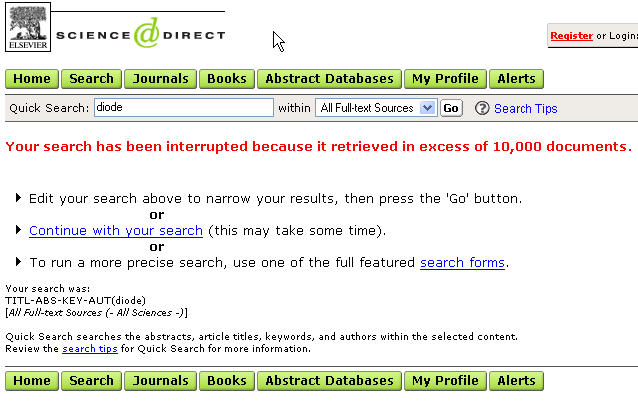
btw it was not fun to see the following example from Science Direct when he was explaining that the existing products are out of touch with end users' expectations. In this specific case I would agree with him, Science Direct should be able to give search results even if there are more than 10,000 records.


Product Development at its Best: Spell with Flickr

I am at the NFAIS conference and I wanted to create something using Spell with Flickr to show it to the audience as a cool product. Last night I sent an email to Erik Kastner who created the product and ask him how to do it, and today he integrated RSS feed into his product and solved one of his user needs. Lessons for all the product development folks: launch the product, get the feedback from users (i.e involve them in the product development) and improve it in a short period of time. Erik, thanks for the listening and solving one users problem

Saturday, February 25, 2006

Spell with Flickr and get a logo

Spell with Flickr is created by Erik Kastner using Flickr's API. Again creativity in action...

Here is how Elsevier, Scopus and WOS Thomson look.


Friday, February 24, 2006

Thursday, February 23, 2006

Good job Google

Google celebrates National Engineers Week and Introduce a Girl to Engineering Day by inviting hundred of middle school girls to their office to spend the day with engineers.

"We hope these girls get a real-life sense of what it's like to work here, and more important, that we've piqued their interests and ultimately help steer them toward future careers in math, science and engineering." link

I checked Elsevier, CSA, Thomson and our (Ei) websites and there is no mention of National Engineers Week. As we are serving engineering community, I think we should be active in this Week and sponsor the National Engineers Week Foundation which was founded by National Scociety of Professional Engineers in 1951.

SiloBreaker Launches in the US

I had already mentioned when they launched their product in Europe, now from a press release I learned that they are starting marketing Silobreaker in the US too. link

Their business development director Mats Bjore, who was a Lieutenant Colonel with Swedish Military Intelligence states what all the online information providers should be doing to be successfull in this challenging market when we are all facing all these PhDs at Google, Yahoo and Microsoft who might be working to create innovative products like Google Scholar that will compete in our market:

"Unlike large content aggregators and Internet search engines, Silobreaker is a powerful discovery tool that turns information into intelligence by converting unmanageable noise into a source of insight, and delivering related and relevant knowledge quickly, efficiently, and cost-effectively" [bolding is mine]

For now as GYM products are not providing any intelligence at their search results Silobreaker and other online information providers are filling this need for the end users.

Sikobreaker is a joint venture of Infosphere, (based in Sweden) and Elucidon (based in UK with offices in Sweden) I have worked with Elucidon in the past and it's a great team of smart and professional people.

I like the Silobreaker's pricing strategy which reminds me another Swedish company H&M which provides quality fashion at low price to the masses.
I wish them all the success in their new initiatives.

Wednesday, February 22, 2006

Official Google Research Lab

Peter Norvig who is the Director for Google Research explains what Google Researh is. via Greg Linden


He mentions that "Some of us are launching projects on google.com this week and wearing pagers, and some of us are working on goals for the year 2020." I do believe that when he says 2020 he means it.

Is there any STM publishing company who can articulate clearly their goal for 2020 or let alone 2012?

I was wondering what kind of information sources and products all these PhDs are using? Is Google Scholar their first source for scientific literature research?

Global R&D Investment will exceed one trillion dollar

"On a planetary scale, annual budgets devoted to R&D will soon exceed one trillion US dollars. According to UNESCO Science Report 2005, [pdf] investments were all ready up to $830 billion in 2002 and were allocated as follows:
  • 37.0% in North America, with 35.0% in the United States;
  • 31.5% in Asia, with12.8% in Japan, 8.7% in China and 2.5% in India;
  • 27.3% in Europe, with 6.7% in Germany, 4.2% in France and 3.5% in the UK;
  • 2.6% in Latin America and the Caribbean, with 1.6% in Brazil;
  • 1.1% in Oceania;
  • 0.6% in Africa, with 0.4% in South Africa." link
via Birchbob

Tuesday, February 21, 2006

GM's Vice Chairman's call for input from customers

"But the deeper issue is this question of our image, and this perception that nobody’s interested in our products. We can and will do a better job of advertising and communications in the traditional sense, but we need to step up our non-traditional communications and word of mouth, and get our message directly to the people on a grass roots level. This blog is one example [the bold is mine]— but we need more avenues, and bigger ideas. What do you think?" link

I haven't driven a GM in my life -I had two cars since I've been in the States one Toyota and one Golf (92) which my kids are begging to me to change it- so I can't give any input what's wrong with GM cars but what he is doing is exactly what I have been trying to tell to my colleagues: create avenues to have open and no spin communication with customers. They will tell us the good and the bad, we'll understand their needs better and build better products.....

Monday, February 20, 2006

AJAX Desktops

Dion Hinchcliffe writes about AJAX desktops and summarizes the benefit. I have been playing with Live.com, netvibes and PageflakesI can imagine very interesting ways using these applications in corporate and academic library environments while helping specific departments or researcher or faculty with their information gathering actvities from multiple sources that the institution has access (granted that these sources are providing RSS feeds)

Consumers wish list

Seth Godin's list include:

"interaction
expectations exceeded
respect"


I would add truth and simplicity to the list.

Online STM Publishers & Mashup

I went over the participants list of the Mashup Camp and did not see one representative from STM online publishing world. I bet some of these creative guys can come up with some cool application using our content and make it more interesting to end users. How about doing a citation tracking from Scopus or Thomson content using Google or Yahoo Maps? Or may be Anurag Acharya's group of handfull developpers can do this within few hours and integrate in Google Scholar?

Sunday, February 19, 2006

Let's bring some fun to STM search

Steve Pappa who is the founder of Endeca sent an email to facetedclassification group on their NCSU implementation and he mentions one of the NCSU student's reaction to faceted searching:

"The new system is incredible. It would be difficult
to exaggerate how much better it is than our old online card catalog
(and therefore that of most other universities). I've found myself
searching the catalog just for fun, whereas before it was a chore to
find what I needed." (bolding is mine)
To all the online information providers including (Reed-Elsevier & Thomson) if you are not using faceted search in your (subscription-based) products you are doing a disservice to your customers.

As far as I know Engineering Village 2 and Scopus are the only subscription based products in Reed-Elsevier leveraging faceted searching. If anyone reading this post from Thomson or any other STM information providers (Dialog, Ovid, CSA), I'll be glad to include your products in this post if you send me a note with your faceted or guided navigation implementation.

From the War Zone: Scopus Citation Tracker survived the Thomson attack

I am really having fun with the war analogy of the media. Information Word Review's headline: Thomson attacks Scopus Citation Tracker feature. via William's post at Issues in Scholarly Communication .

In the article Boby Pickering quotes Jim Pringle who is the VP of product development at Thomson and Amanda Spieteri who is the product marketing director for Scopus.

I am all for competition but I am not for "attacking" my competitor. Last year at NFAIS meeting in Phili, after watching Thomson Pharma presentation by Rachel Buckley who is the Director of Product Development for Thomson Scientific, I approached to her and complemented their work on Thomson Pharma.

Scopus and Web of Science are competing in the same market. It's like Google and Microsoft in search business. Users have different needs when they do a scientific search, and some of them are not even interested in citation searching. I think we should hear from the end users who are using these products. Let them decide which one they prefer to use and why (we may found out some of them may want to use both too) and send their feedback and comments on Scopus and WOS.

May be we should create a wiki or blog under WOS-Scopus and let the end users post their comments and feedback there. We can all learn from an open communication with our customers and improve the products.


Saturday, February 18, 2006

Howard Country Library 's Aquabrowser Search Interface

Christina posts about another faceted search and visual implementation which is very nice in Howard Country Library . The system was developped by Medialab in Netherlands

Review of Compendex on Engineering Village 2

Meghan Lafferty from University of Minnesota and Kitty Porter from Vanderbilt have a review of Compendex on Engineering Village 2 in Issues in Science and Technology Librarianship, Fall 2005

I am glad to see that they are fan of EV2 and thanks for taking their time to review our product.

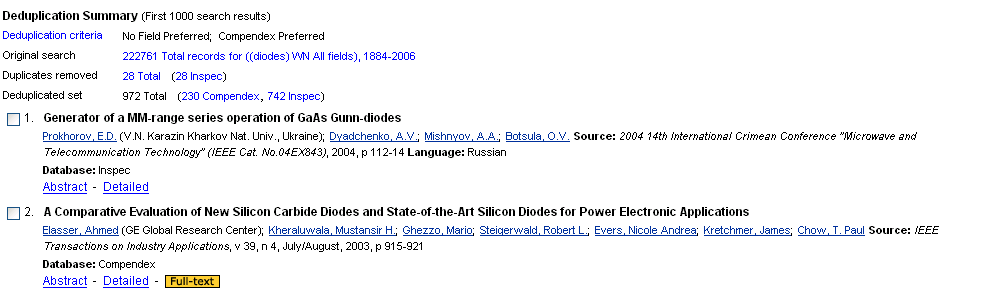
Since they reviewed the product, we have revised our dedupping feature and resolved one of the complaints that we were getting from our users who have access to Compendex and Inspec which Meghan and Kitty righfully pointed as "Unfortunately there is no indication of how many records have been removed."


With the new dedupping the end users will be able to see the number of deduplicated search results, the number of duplicates which were removed by databases, and original search number.

They also point out that we need to make our Help Document (Pdf) easier for end users.

"Easy to access online, in the print version the table of contents needs to be revised to allow quick access to the section on Faceted Searching. Currently the entire document has to be scanned to find it under Refining Results."
I agree with them. I think we need to revise not just our print version but our online version too. That's something that we'll work this year.

Blogistan or Blogosphere?

Thanks to Christina I learned a new term desribing all these blogs: Blogistan. I would prefer Blogistan instead of Blogosphere. Let's see which restaurant will serve blog brulee?

Thursday, February 16, 2006

Faceted Search and Humanizing Search

Interesting way presenting the value of faceted search

"Siderean's navigation solutions are 'humanizing' enterprise search by allowing users to find information in a more intuitive way that emulates the way we think rather than forcing us to follow the processes defined by today's search tools," said Anderson. "Navigation takes search to a new level by providing information in a more natural, organized manner. It also leverages the latest technology advancements like facets, tagging and visualization to allow users to quickly go from a bird's eye view of the entire scope of data related to the question they are trying to answer before they drill down, to a bug's eye view of the exact information they need to make mission critical decisions. By combining our game changing navigation capabilities with search, Siderean is poised to fundamentally transform the enterprise search market." via HighBeam


I never thought that we were humanizing search using faceted searching, but hey if users find this way of searching more humanly that's fine with me.

Couple years ago I was talking with Keith Instone and getting his input in our implementation and he said something like "faceted search brings fun to the search process". He is absolutely right, besides all the value that one gets from the facets, it's really fun using the facets and dynamically changing search queries.


Wednesday, February 15, 2006

GooglePark

Here is a nice example how Microsoft and Google can have some fun while competing via Scoble

Tuesday, February 14, 2006

Google Scholar: Potentially Good for Users of Academic Information

After the previous post it's interesting to read the following positive comments for our competitor Thomson in Fred Friend's article

"The challenge for Google will be to develop a rapport with the academic community so that its services become as deeply embedded in the work of that community as open access repositories and journals are becoming. There is a commercial example for them to follow in the success of ISI, [8] whose citation products are used in research assessment in many countries. ISI's dominance of this market has led to some criticism of its role, but as an example of a commercial company becoming a key player in academic life it is unrivalled. ISI has reached that key position by understanding the importance of quality issues to both academic and publishing communities, and using the contacts its staff have had with those communities to design services which benefit both. Google has a similar opportunity, through its understanding of the importance of searching Internet resources, but its staff needs to develop close links with academic users if the opportunity is to be realised."


For tonight Phili 1-Amsterdam 0 (let's have some humor folks...)

Monday, February 13, 2006

Update on Scopus

A new update from David Goodman and Louise Deis on Charleston Advisor

"We now amend our statement: the true state of affairs is even worse than we imagined. All publishers of journals or databases make errors or leave gaps, but responsible publishers correct at least those called to their attention--especially those called to their attention in public. What will get Elsevier to fill in gaps and produce a complete product? Apparently nothing--while there are libraries who will buy it knowing that 10% percent of the titles are incomplete, Scopus does not even try for a more complete product. This is not the attitude of a responsible publisher."

This is a tough one for me to swallow. I do sincerely hope that my Scopus colleagues start a conversation and explain the situation to Goodman and Reis and the market.

Ad Supported Book by Harper Collins

Go It Alone is free to read, if you are willing to see ABG (ads by google) via MIT Advertising Labs

What would be librarians and their customers reaction if the online information providers like Elsevier and Thomson start offfering some of their content free, and present sponsorship ads with the search results?

Sunday, February 12, 2006

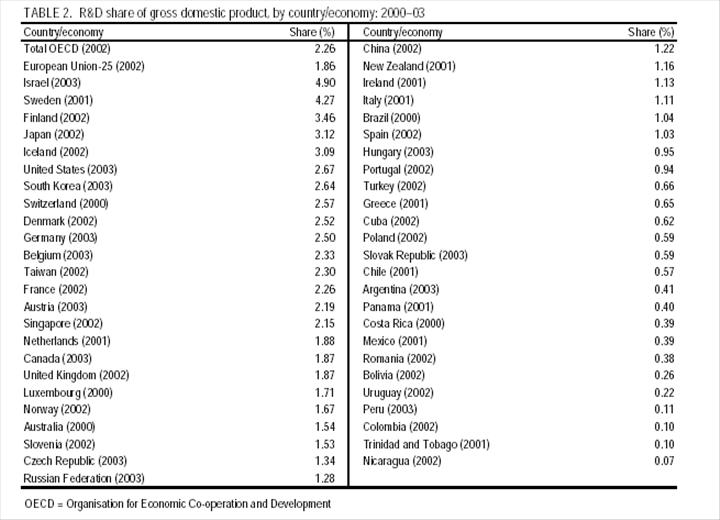
R&D Share of GDP


Israel is leading the list, with Turkey being the only Muslim country in the list. From NSF

Also The National Science Foundation projects 2004 will show continued growth in U.S. R&D to $312.1 billion.

Presentation of Search Results is key.

Tamar Sadeh from ExLibris touches a very important point in her article "Google Scholar Versus Metasearch Systems" onHEP Libraries Webzine Feb 2006

"Beyond searching

Google Scholar may provide an easy way to search. However, with the constantly increasing quantity of scholarly data, Google Scholar will soon be facing a new challenge, as will database providers and metasearch systems: the comprehensive presentation of search results to the user.

The assumption underlying the implementation of relevance ranking and its use as a sorting order is that end-users will not scroll down and scan large amounts of data. Therefore, the results that are most likely to suit their research needs should appear at the top of the list. However, this sorting order has several drawbacks. As mentioned earlier, users have different research needs, and an item that is most relevant to one user may be less relevant to another.

Another problem with presenting search results in any type of linear list is that sometimes there are a great many results. Some users, particularly those who are novices, may not know how to define their queries effectively; however, once the system analyzes the set of results and provides options to narrow down the list, such users can easily drill down to the relevant subset of results."

That's one of the reasons that we implemented faceted searching in Engineering Village. Tamar gives Vivisimo and FAST as companies which are custering search results.

Gmail going to campuses

Gmail is testing a service with San José City College (SJCC) where they will host Gmail accounts with SJCC domain. via Official Google Blog

Thursday, February 02, 2006

Google Fifth Largest information industry company

"Google became the fifth-largest information industry company - up from 18th. It trails leaders Reed Elsevier, Thomson Corporation, Time Warner, and Gannett. Yahoo became number eight, up from number 18 in 2004"

"Overall information industry revenues rose 7.7 percent to an estimated $285 billion in 2005, with Google and Yahoo together accounting for some 5 percent, according to the Outsell report."
via MarketingVox

Now that's a challenge for us (reed-elsevier) and Thomson......

Wednesday, February 01, 2006

Ei Patents is Live

Our development team did an excellent job, and created a great (IMO) implementation of USPTO & esp@cenet patents. The clustering of the results with scientific literature (Compendex, Inspec, NTIS) makes this implementation a great help for technology and competitive intelligence. Everyone is talking about the "SRP" Search Results Page. Here is a nice way to provide insights at the search results page.


Check it out and send us your feedback. (You need a subscription to see the Ei Patents. You may contact your account manager if you want to get a trial)


I said to a colleague having the option to drill down the search results and easily change your search strategy makes the searching and finding a "fun experience."

Just be a Mensch

It's always good to be a mensch whatever you do, interacting with friends, colleagues, competitors, customers. I was kind of suprised to see the mention of mensch in Guy Kawasaki's presentation: Selling the Dream.

Here is the movie on mensch: We Need a Mensch I think Ben Barak is a real talent and funny guy.