Sunday, December 31, 2006

Since when bloggers can't post on old news that newspapers are reporting?

When I started this blog I never thought that I was supposed to "be able to break stories faster than mainstream journalists. " I am not keeping this blog to compete or break stories faster than mainstream journalists. I saw an article in a newspaper about a company that I liked what they were doing with faceted search and I posted. It's so simple and let's keep simplicity for blogging..... btw Steve Rubel, Techcrunch, Mashable has more insights and better coverage than my single line about Rawsugar.


Friday, December 29, 2006

Unconference in East Village

Last night I went to an "unconference" that Dave Winer held in my neighborhood. The discussion was around patents, Apple's stock option and the naming of unconference and what it is and it is not. I don't understand why people are consuming so much energy and brains and trying to define what unconference is or is not. Basically that's an open discussion with a moderator where like minded people are gathered and chat and meet interesting people. Let's not try to create a patent on this.......

RawSugar is closing shop

Rawsugar which is using faceted search with tags is leaving the bookmarking space

First Exlibris, then Endeavor and now SirsiDynix

SirsiDynix was acquired for $1B by Vista Equity Partners, another private equity..............................
No wonder why some people are queueing for Ferraris

Wednesday, December 27, 2006

Semantic Web

Jim Hendler from Mindswap Web is looking the earliest mention of Semantic Web. I checked Engineering Village and so far I found an article from 1993.

Metamorph: natural language and more

Open peer-reviewed encylopedia

Scholarpedia is a free peer reviewed encyclopedia written by scholars . Each article has a curator They also started something that I like Scholar Index which measures the reviewers contributions to articles like this. via Ben Vershbow

You Tube in scientific communication and teaching

Jean Claude Bredley whom I met few years ago when we did an e-learning prototype at Drexell with Jay Bhatt's help is doing some very interesting stuff in his class. Here is how he is using video, leveraging google co-op, blogs and wiki in his teaching and making learning experience more fun and open.


Tim Berners Lee on Semantic Web

The Economist has an article of Time Berners Lee titled "Welcome to the Semantic Web" (subscription req) on their "The World in 2007" section

"Data integration will be the web’s next leap forward. The most exciting discoveries will come from the serendipitous combination and integration of data drawn from diverse sources."

"The Semantic Web will derive its power in a similar way, but through the linking of data rather than documents. To appreciate the need for better data integration, compare the enormous volume of experimental data produced in commercial and academic pharmaceutical laboratories around the world with the frustratingly slow pace of drug discovery. Life-science researchers are com­ing to the conclusion that in many cases no single lab, library or genomic data repository contains the informa­tion necessary to discover new drugs. Rather, the infor­mation needed to understand the complex interactions between diseases, biological processes and the vast array of chemical agents is spread across disparate databases, spreadsheets and documents. As a result, progress towards better drug discovery de­pends on technologies that enable sharing and integration of data, as well as on changes in institutional practices in order to allow exploration of the links in these data."

This is not to suggest that all pharmaceutical companies sim­ply free their data, but rather that they explore more flex­ible licensing models that allow greater value to be created through the combination of their own intellectual prop­erty and that of others. For this sort of integration to happen, an essential technical step is to publish the data using Semantic Web standards (RDF, OWL, SPARQL), and to link them together with definitions of the terms used to express the data. For example, when publishing experimental results about the behavior of a particular chemical in a larger biological process, one must indicate which vocabularies are being used to describe the biological pathway and the chemi­cal. Then, when someone else wishes to integrate those data-for example, with other experiments documented in the research literature-that person can use that same vocabulary to match article keywords to chemical names. via JLReis

Monday, December 25, 2006

Open Science

In the coming years we'll hear more about Open Science.

"One of the biggest drivers for open science, regardless of how it is defined, is the transparency that it brings to the scientific process. Fundamentally most scientists are interested in furthering knowledge and I think the general attitude of scientists, where they are always afraid of being scooped, or reluctant to share data is misplaced and against their own general convictions. It is for that reason that I think that over time academic research will increasingly start moving in the direction taken by the Creative Commons license." via bbmg


ps 303,000 records in Google today for "open science"

Librarian is one of the best careers for 2007

US News includes Librarians as one of the best careers for 2007.

"Even though anybody can do a Google search, for instance, librarians will be needed more and more to help us navigate all that digital information."

Information professionals are playing crucial roles today in corporate, academic, government and public sectors. They are helping their institutions to save hundreds of thousands dollars or even in some cases millions of dollars by helping their clients to find the right information without wasting time. Compared to insane and absurd Wall-Street bonuses, this field deserves a higher median salary than $49,708.

Wikipedia Explorer and Visualizing the search results


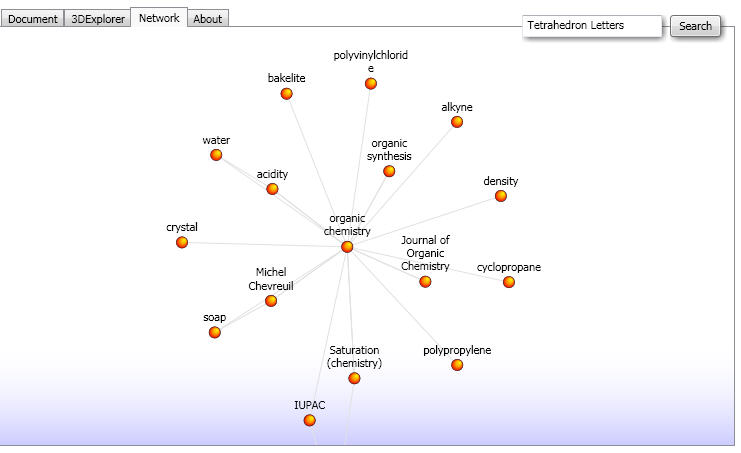
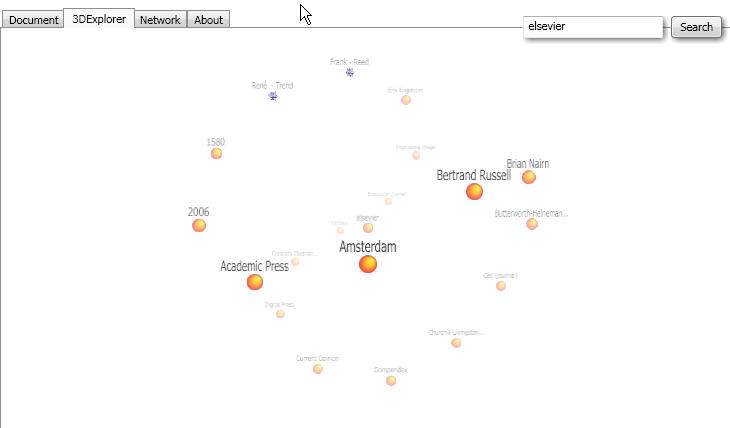
DotNet Solutions created a very clean visualization of Wikipedia search results using Windows Presentation Foundation. via Dan Fay

"Compared to the standard text only view of articles, Wikipedia Explorer deals with and displays the relationships between the articles.

With the display of the data, the application allows 3 forms of view. An initial Document layout displays the article's content as it would be displayed in Wikipedia itself. The real value of the application however, is in the extra 3DExplorer and Network view modes.

Within the 3DExplorer mode, the main article is displayed in the centre of the screen with all linked articles shown around in a helix structure for quick navigation"


It would be an interesting experiment to see an application like this with scientific full text journals and books in Science Direct or even with one of our abstract and index databases.

Sunday, December 24, 2006

You the Widget

Get this widget!


First it was Time with "You", now Newsweek with "Widgets"


Here are three feeds that I am susbcribed ( Rich Hoeg (Honeywell), Jerry Bowles and Mathew Hurst) in a RSS reader widget from SpringWidgets

Saturday, December 23, 2006

Talmudic explanation to Steve Gillmor's post

In case that you were wondering what Steve Gillmor was trying to say about Jonathan Schwartz CEO and President of Sun Microsystems , thick client, and Dave Winer; Joel Spolsky explains it in Talmudic tradition.

Amazon's investment in Wikia and Jimmy Wales new venture in search engine

Now it makes more sense why Amazon invested in Wikia. Jimmy Wales the founder of Wikipedia and Wikia is planning to launch an internet search engine with amazon.

Wales believes that "Google’s computer-based algorithmic search program is no match for the editorial judgment of humans."

In the Times article Wales also said that "Google is very good at many types of search, but in many instances it produces nothing but spam and useless crap. Try searching for the term ‘Tampa hotels’, for example, and you will not get any useful results"

Friday, December 22, 2006

"Magic Bullet" for publishers

"In large part, then, social media has succeeded in most areas in spite of itself: the virtues of revolutionary tools far outweighed a host of vices. But the aftermath of this revolution will begin to favor focused products that go beyond single-purpose general solutions to products that solve real problems for specific audiences using social media techniques"

"This is the "magic bullet" that many publishers will be seeking to fire in 2007, a way to harness the benefits of social media technologies into a form that will translate into specific market opportunities." via Shore Commentary
Good advise from John Blossom who is the President of Shore Communication and one of the must read analysts of our industry.

Thursday, December 21, 2006

Semantic Web Applications

Will semantic web applications come off age in 2007? I do hope so!
If you are interested and find out more about semantic web I would suggest to read Nova Spivack's paper on the Meaning and the Future of the Semantic Web. Nova is the founder of Radar Networks a company that is in stealth mode and is "building technology for enriching content that will catalyze the evolution of a new dimension of the Web."


Semantic Web Applications

Will semantic web applications come off age in 2007? I do hope so!
If you are interested and find out more about semantic web I would suggest to read Nova Spivack's paper on the Meaning and the Future of the Semantic Web. Nova is the founder of Radar Networks a company that is in stealth mode and is "building technology for enriching content that will catalyze the evolution of a new dimension of the Web."


Nature stops the wikipedia like experiment

Wall-Street Journal reports that Nature drops online editing contributions due to lack of participation. First, scientific publishing community should give them credit having the guts for testing and experimenting the idea. The details of their experiments is presented at Nature's site
Eventhough Nature stopped the experiment, journal and books publishers should continue to think and explore ways to bring users participation in the web.

Wednesday, December 20, 2006

Review of Scopus, WoS and Google Scholar

An indepth (63 pages) review (pdf) of Scopus (Elsevier) and Web of Science (Thomson) by Bosman, Mourik, Rasch, Sieverts, Verhoeff from Utrecht University Library. The review includes a comparison of these two services with Google Scholar too. Researchers also conducted a survey among 81 users at the University and the overal result was :

"Scopus therefore significantly outscores Web of Science, both in terms of its user friendliness and the quality of hits." via WoW
The survey also shows that Scopus and WoS are less well-known than Google Scholar.

It will be very interesting to see how these two products will enhance and differentiate their services in 2007. I strongly believe that the one who is going to stay focused on the customer, listen to the users and develop the product to solve customer problems will be the winner at the end. I do hope that they won't start copying each other, but develop unique enhancements that would enhance scientist and researchers life.

Tuesday, December 19, 2006

Microsoft and Scientific Desktop

"Microsoft Windows Compute Cluster Server (CCS) 2003 is a new HPC [high-performance computing] operating system specifically designed for group and departmental-level deployment. CCS contains everything you need to deploy a Windows-based cluster quickly and easily, even if you're not an HPC expert. Combined with the scientific resources available through iNquiry, CCS provides a powerful and scalable HPC platform for bioinformatics researchers, that installs rapidly and is easy to use." via the BioTeam

For more on this check Dan Fay

Monday, December 18, 2006

American Apparel and Proquest Acquisition


Two different acquisitions within few days and both of them is around the same figures.

Cambridge Information Group (parent company of CSA) acquired Proquest for approximately $222 million. American Apparel was acquired by Endeavor Acquisition Corp for $250 million. Why I am personally interested with these two acquisitions? I have been always interested in fashion (my father used to sell fabrics and my grand parents were tailors) and I work in the information industry. I don't think that American Apparel has brought anything to the fashion world beside using Los Angeles labor and some funky marketing. On the other hand my friends Lexy and Vahap are doing some really exciting stuff in fashion and reatiling with their Brooklyn Industries. Good luck to American Apparel when they expand to overseas and with their IPOs.

CSA's acquisition of Proquest will help them in expanding their market in the corporate R&D world. This is a bold (and courageous) move by CSA and definetly a much better investment than buying a t-shirt company when you think about the profit margins of apparel industry.


Semantic Web Services Mashup Competition

Clearforest announced the winner of their 2006 Semantic Web Service Mashup competition: Newstracker via Yahoo

There are some other interesting applications to look at too.

Hype-List

Newsmakers of the Day (NOT'd)

Six Degrees

Compare & Contrast

Semantic Searcher

PowerRSS

Thursday, December 14, 2006

Corporate R&D spending and corporate success

Booz Allen Hamilton's second annual study (pdf) among 1000 largest corporate R&D spenders shows that just investing in R&D can't buy success. (similar to money helps, but does not bring happiness)

"Money simply cannot buy effective innovation. There are no significant statistical relationships between R&D spending and the primary measures of financial or corporate success: sales and earnings growth, gross and operating profitability, market capitalization growth, and total shareholder returns"

"
Boosting R&D spending can increase the number of patents that a company controls, but there is no statistical relationship between the number or even the quality of patents and overall financial performance." via strategy & business


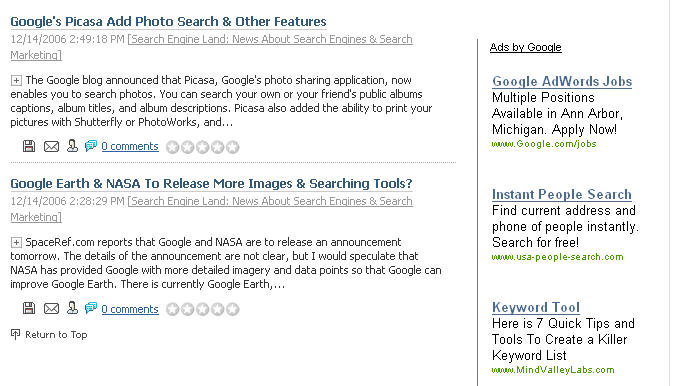
Plenty of Google Ads in my Newsgator today


This afternoon I noticed for the first time the Google ads.

Wednesday, December 13, 2006

News at Seven


An interesting project from Northwestern University that "finds the news you are interested in; edits it; finds relevant images, videos, and external opinions; and then presents it all using a virtual news team working in a virtual studio. It would be interesting to create something similar for research information that one is interested in.

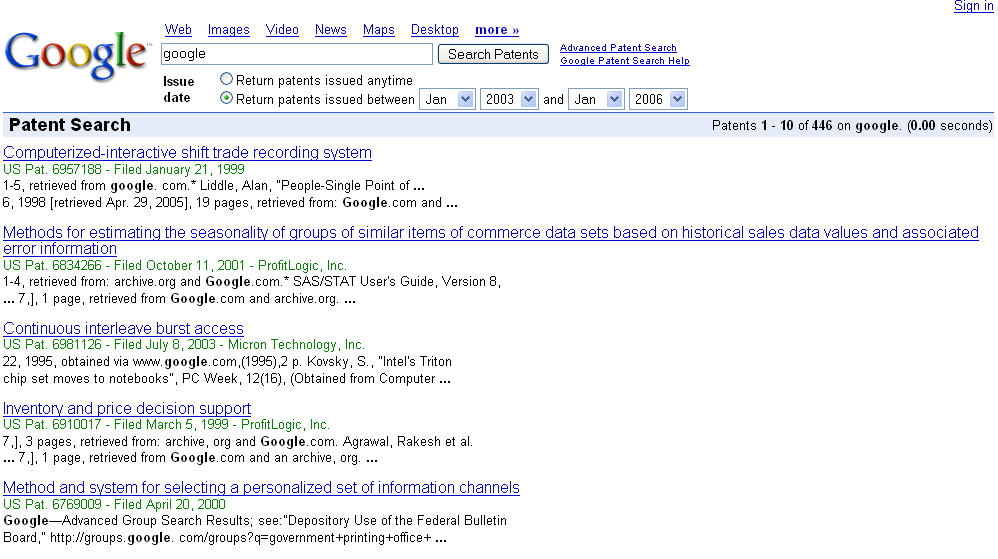
Google (finally) launches Patent search

I love challenges! And if this is coming from Google, that's more exciting for me. After Google Scholar now we have Google Patents. As fee-based publishers (Elsevier, LexisNexis) this is another great opportunity for us to show to the market that providing (or dumping) information is not enough, we provide knowledge and insights when you use our patent services.

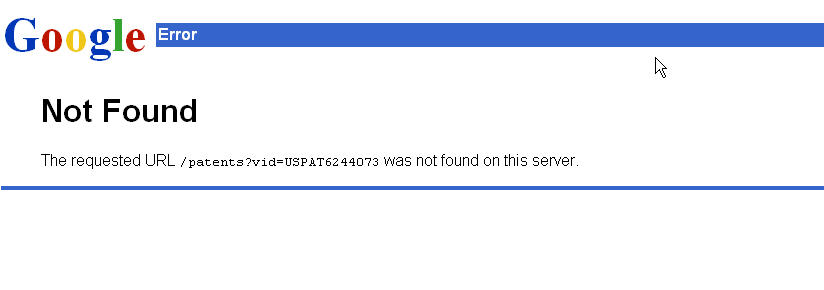
Here is patent search results for Google in Google Patent search. As I said before for Google Scholar, we just get the records at the search results and no intelligence or insights that can be associated with these records.


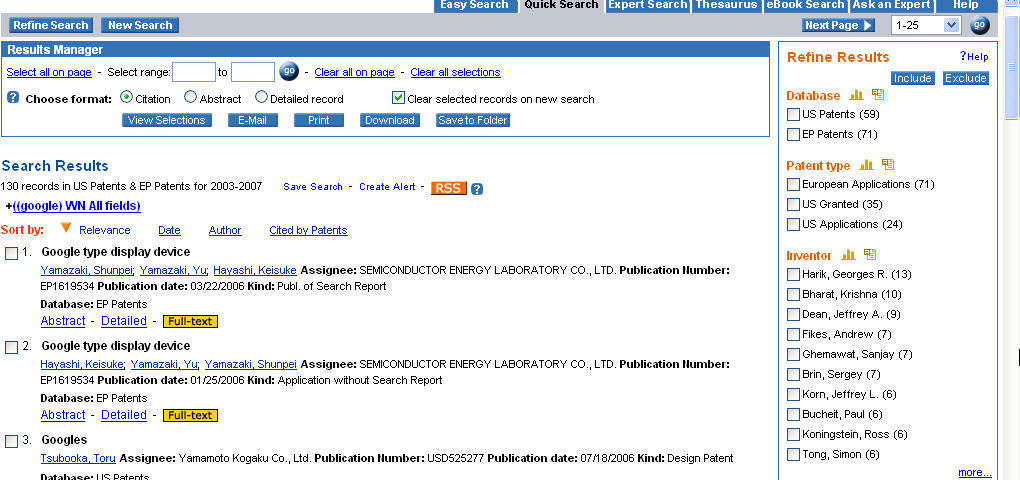
and here is the same search with Ei Patents where at the search results page you get the knowledge and insight on who is the most prolific inventor using the facets.


Google has few bugs right now with the implementation but these are small stuff that they can easily fix it.

Their implementation looks like it's better than USPTO's site. I still can't figure out why Google does not implement any clustering technology with their search results for patents. via Google

Semantic Web experiment


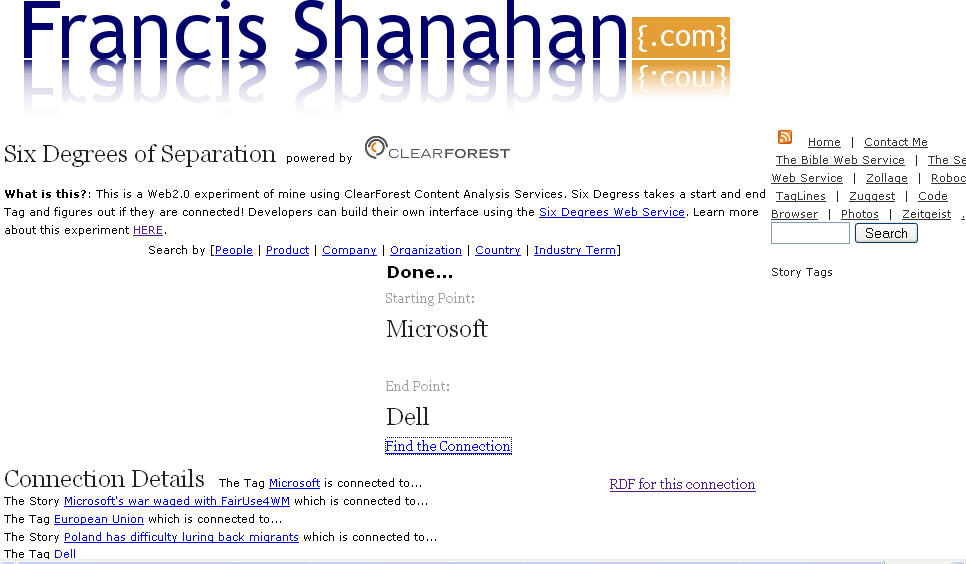
Francis Shanahan's experiment "Six Degrees" uses ClearForest web services, RSS, AJAX and RDF to find connection between people, companies, product, organization, country, and industry term.

Monday, December 11, 2006

Encyclopaedia Judaica 2nd Edition and Online Reference

Until today's announcement I did not have any clue that Thomson was the publisher of the Encyclopaedia Judaica. Growing up in Istanbul this reference material was the envy of every Jewish household, unfortunately there was not too many household who could have afforded buying and bringing this from Israel or Europe. Some families used to give this as a bar-mitvah present to their son. When needed I use to borrow one or two volumes from my friends. Fast forward 34 years, Thomson and Keter Publishing House announced a new edition of this "historic" reference material.

It seems that both publishers are providing just the print($2,095) version, and there is no online version of this encyclopedia. There is a ebook price ($2,195) but I don't know how I can access to the ebook. I tried to link to the site but I was getting an error message.
In today's world where Wikipedia is gaining popularity as a reference source, if I was publishing this I would definetly create an online version and sell access in different options a) unlimited usage subscription with no advertisement b) unlimited usage subscription with ads c) pay-per-day (month) access with ads d) pay-per-day (month) access with no ads e) pay-per-page etc

I know that I am not going to spend $2,000 for this (one of the reasons is space, I don't have space to hold close to 30 big volumes) but if it goes online Thomson has more chance conversting me into a customer.

Friday, December 08, 2006

Creative approaches for knowledge workers

This past Tuesday I participated to a Library Connect meeting in Boston and had the chance to meet with our customers and saw and hear from Rich Hoeg, the creative stuff that Honeywell is doing for their knowledge workers. Indeed if you are interested to find out how a corporation is using and leveraginf RSS, blogs, podcast, wikis I would suggest to subscribe to Rich's blog. He provides great insights from his and also other companies experiences.

In my presentation which I called it "Rapid Fire", I showed few slides on a new tagging feature that we plan to launch in Engineering Village early 2007 and today I was glad to read Mary Ellen Bates's recent article at econtent where she says that

"... we will start seeing more creative approaches to tagging content that already has controlled vocabulary indexing. We can add user-generated tags to an existing taxonomy". via info pro

Watch this space for the new Engineering Village features that we hope will increase collaboration between our users and give them more control on the information that they are getting.