Sunday, April 30, 2006

Siderean and Dynamic Navigation in entreprise searching

Siderean announces their new software which will allow entreprise users to integrate all their content sources and use faceted searching.

"Enterprises are increasingly overwhelmed by the incredible volume of information coming at them from the Web and their own databases, desktops and files. Their ability to manage this information overload and provide users with the tools they need to find what they are looking for is currently falling short."
said Robert Petrossian, CEO of Siderean. Siderean solution should be a welcome news for any entreprise users.

I wish we had a faceted search or dyamic navigation feature in Elsevier's intranet which would improve everyone's search experience and really help us to find what we are looking for.

Friday, April 28, 2006

Tegrity has good solution for students

An Israeli company Tegrity has come up with a system "to record their [students] notes onto the Internet while writing them in class. At the same time, the professor’s lecture is recorded on video for review in the archives of the university’s website." via ArutzSheva
Here is an example of Tegrity system for an engineering course. I wish I had access to a service like that when I was in university.

Here are some universities which implemented their solutions . Let's see which publishing company is going to invest or buy them out. We all talk about improving "the workflow". This a good example of students workflow.

Honeywell gets it: Internal blog for Engineers

Rich Hoeg announces Honeywell's first internal blog server. No wonder why Honeywell was listed as companies to watch in the Innavora report. You need people with vision from the field and managers who are willing to take risks and trust their people in order to accomplish something nowdays. Excellent move by Honeywell. I hope that we will see more engineering companies moving into this direction. Next we need to figure out how to connect all the engineers globally to share knowledge and speed up innovation in their companies.

Google moves into clothing business

That can can happen in Istanbul. Need to check with friends in Istanbul and see where this place is. via Barry Schwartz

Thursday, April 27, 2006

Facebook for corporates?

Facebook expands to corporate. I tried to register with my elsevier email but could not get through but we are not there yet. Who knows what was their criteria picking up the following companies: (via insidefacebook & Michael Arrington )

Wednesday, April 26, 2006

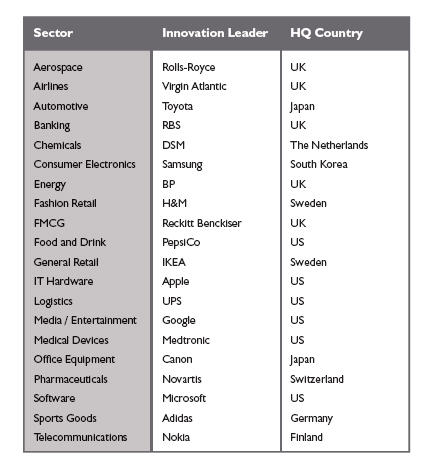
Most innovative companies in the word


Dominic Basulto from BusinessInnovationInsider posts about Innovaro's report that lists top 20 innovative companies in the world. Sweden has two companies in the list: H&M & IkEA.

What about publishing? Who is the most innovative company in Publishing? O'Reilly or Nature

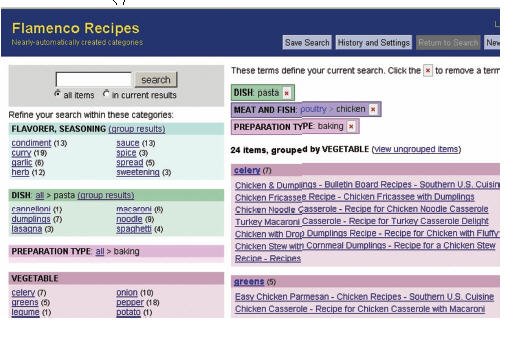
Flamenco faceted metadata navigation is available as open source software

Prof. Marti Hearst announced the release of Flamenco software as an open source package on sourceforge

Monday, April 24, 2006

A new acquisition from Thomson to expand their Thomson Pharma Offering

Thomson announced the acquisition of Centre for Medicines Research International

hmmmmmm, ?????

Ok, basically we need to switch from being just an "information provider", (Google Scholar or Windows Academic Live are doing this), to "knowledge provider"; the winner will be the one who can provide actionable insights, intelligence and knowledge to their customers.

It seems that this is a good move by Thomson.

Raytheon an early adapter in tagging behind the corporate fire-wall

David Weinberger mentioned about the discussion on taxocop about social tagging in corporation on Friday and now Steve Boyd and Alex Barnett picked this up.

Here is how Chrisine Connors from Raytheon is implementing a hybrid model withing the entreprise:

"Raytheon, successfully uses social tagging in a hybrid approach. At Raytheon, people submit website suggestions (URLs) along with recommended tags/keyword which are subsequently verified and approved by librarians.
"We only rarely disapprove of a user-submitted term; overly general, vague or completely off-base terms are those that get deleted. We occasionally call to clarify a submission."

She explained more about their approach:
"In search, we insert Suggested Sites in a "feature" box to the right of the regularly ranked results. We do not allow these suggestions to affect the ranking determined by the algorithm. Our surveys show that the sites submitted via this process repeatedly rank as the result deemed "best" for the user's query. It is the single best thing we've done. I can't tell you how much we've spent on formal taxonomies, but suffice it to say that it's enough for me to wonder why I haven't gone into business for myself!"

We should not forget also IBM's experiment with Dogear

Sunday, April 23, 2006

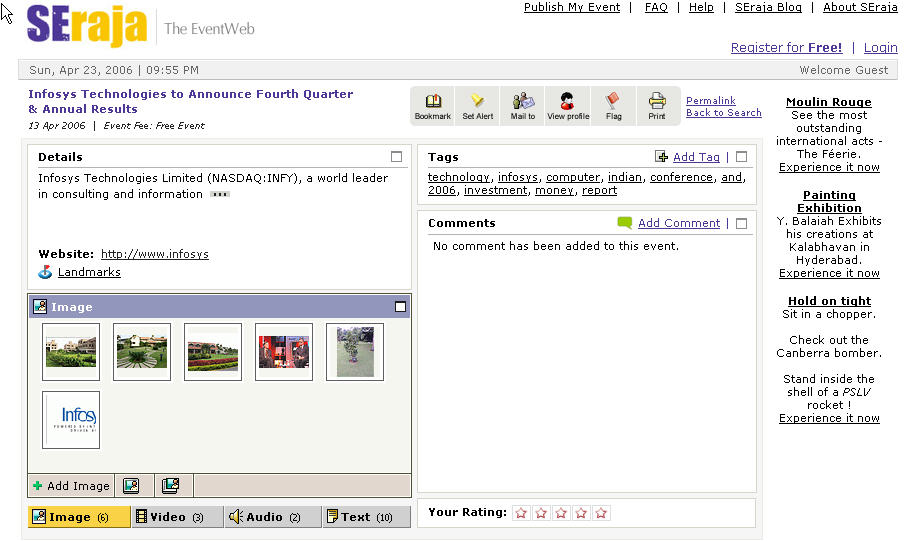
SEraja A new service for event


SEraja aims "to create the experiential engine of tomorrow so people can draw better insights
from events around them." via Rajesh Jain
I like the way they are integrating all the multi-media. It would be interesting and helpful to organize scientific conference and have access to the presentations i.e links to IEEE or Elsevier journals from a system like this.

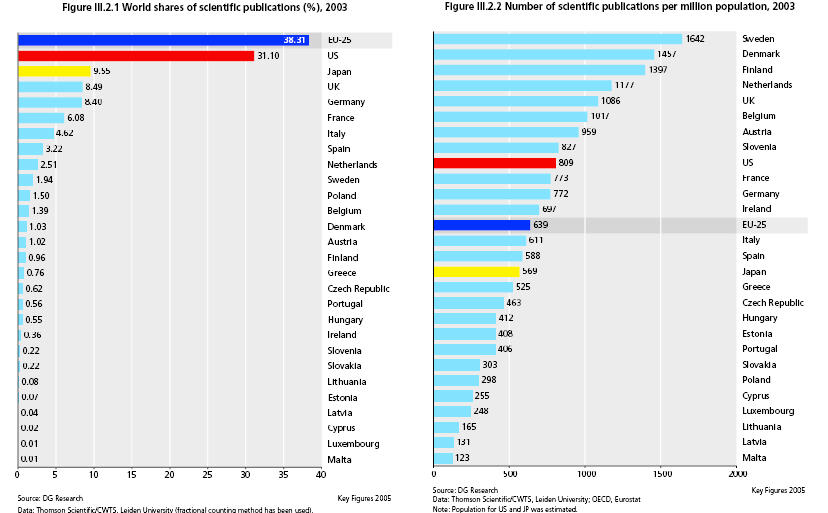
2005 Report on Science & Technology, R&D and Innovation in Europe

EC published a must read report on European R&D for any one who is interested in R&D and science and technology

Some very interesting numbers in the report including this one on the left showing Sweden leading in the number of publications per million population.

Atlas of Science: Oley for SCImago Group

SCImago a research group from in Spain developed Atlas of Science using data from Thomson ISI (via VisualComplexity)

Atlas has the graphic representation of Spanish Science Research from Argentina, Brasil, Chile, Cuba, Mexico, and Spain.

I was wondering if ISI is planning to integrate this project in one way in their offerings like a beta or lab project?
(via VisualComplexity)


Saturday, April 22, 2006

Advertising, Table of Contents and Philips Simplicity for magazine readers


As a magazine reader I want to see the TOC in one page and not spreaded to multiple pages so I like what Philips is doing with Time magazine:

"Philips Electronics, which is gaining a reputation on Madison Avenue for breaking conventions in reader- and viewer-friendly ways, is paying the Time Warner magazine unit $5 million for a novel ad play. Issues of four magazines -- Time, Fortune, People and Business 2.0 -- will feature the table of contents on the first page; a flap on the inside front cover will tell readers Philips is making that possible. The issue of Time that's involved goes on sale Monday, April 24. " from Wall Street Journal (sub)

Philips senior vice president for global marketing Geert Van Kuyck states that "You should expect that we will continue to push the envelope," in advertising.

Geert, I have an idea for Philips to push the envelope in the engineering community. If anyone from Philips is reading this post you may contact me.

Open Source, Opening up the data and Innovation

I had mentioned about Bioforge and now Red Herring has an article on BIOS and Richard Jefferson who is behind the Bilogical Innovation for Open Society and trying to adopt the open source paradigm of IT to innovation in life sciences. Dr. Jefferson aims to

" change the global patent system and how people use intellectual property, and break the grip that the big multinationals hold on the tools of innovation."
Carol Kovac a general manager for IBM health care and life sciences business agrees with Dr. Jeffeorson:
“Discoveries yet to come will be extraordinary but they won’t happen if people lock up intellectual property,”

From "100,000,000 Million Secret" to 100,000,000 million problems for major publishers

David Weinberger could not find a publisher for his new book and now he is going to post the html version online for free, open it for discussion and he will sell the softcover through lulu by print on demand. It's good idea and I would have done the same thing too in his place. When the authors and writers start taking the matter in their hands, this would be a big challange for the publishers in the future come 2015. Reed-Elsevier Venture should be looking at lulu like companies to invest or Elsevier should just buy them just in case if the revolution that lulu suggests succeeds we'll be in the leading position:

"In much the same way, Lulu believes in putting authors and independent publishers in control of their digital content, from content creation to pricing to royalties. Lulu simply brings creative content to the world and gives our talented publishers and web visitors the venue to buy and sell independent works. Publishing through Lulu leaves control of content in the hands of the people who created it. Pretty revolutionary, really."

Confess online using i4giveu: is this the end of going to church, synagogue or mosque

I don't think so.....but who knows what can happen in this medium

Just got announcement from i4giveu that they open it to public. I wish them best luck with their venture. I looked to some of the postings, and I don't get where they will go with all these.

I would prefere to see a social networking company called 4not2sin or 2begood

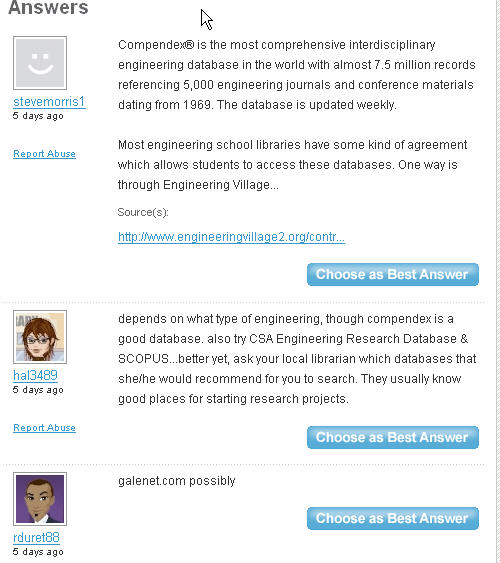
Yahoo Answers choice for a good engineering database

I was testing Yahoo Answers and I asked the following question:

which is a good database to do engineering literature research?
And the answers were satisfactory for me: Compendex, CSA and Scopus

and I also get this valuable advice:
"better yet, ask your local librarian which databases that she/he would recommend for you to search. They usually know good places for starting research projects."

I strongly believe that there is a huge benefit for the scientists, researchers, engineers and students of implementing similar services within all these mentioned products. Indeed Engineering Village's Ask an Expert does something similar behind the wall.

Thursday, April 20, 2006

Dave Winer & Amanda Congdon in the neigborhood

Dave Winer was interviewed on Rocketboom where else in East Village Tompkins Square Park. I hope this interview will not bring too many visitors to the bench and park their cars in 6 or 7th streets as if they are parking them in the desert......

Relevance Ranking a la Google Scholar

announces the new ranking by Google Scholar which is very very interesting. If they continue coming up with these the kind of features they will keep us (Thomson, Elsevier, CSA) awake in the night.

A search for faceted searching shows Marti Hearst's article Finding the flow in web site search which was ranked 4th with regular ranking as the second most relevant record.

Good job Scholar team.

Update: Hopefully someone from Google Scholar would explain why I get the following error


when I run my faceted search using quoation and use the Recent article ranking for I get a record Retrieval activities in a database consisting of heterogeneous collections of structured text from 1992 in the results set when All Articles is used for ranking.

Windows Live Academic & What's lacking in Web Search: Interactivity and Context

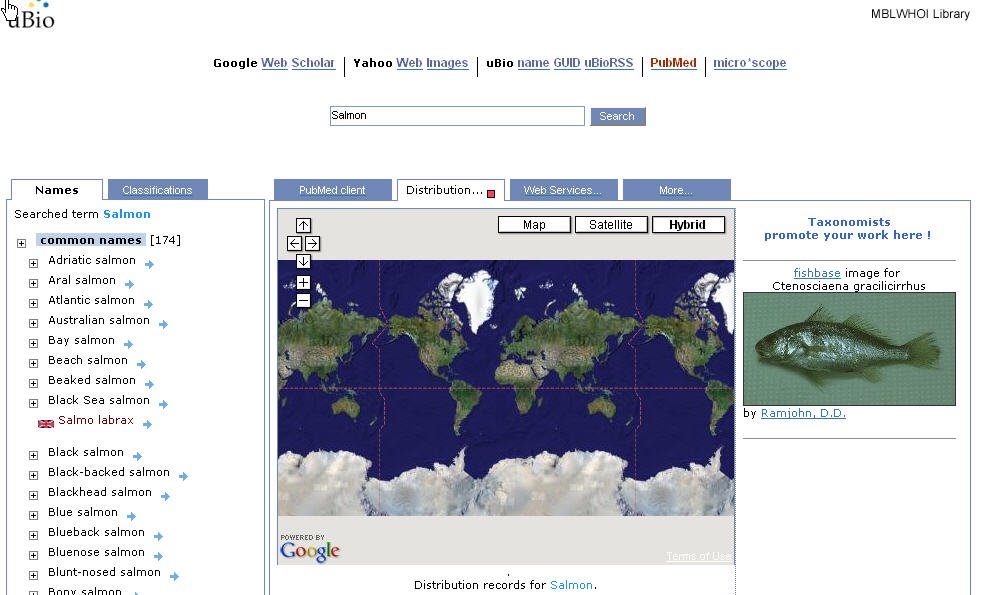
I was in London with the family for the holiday visiting the in-laws and did not need the s-chip . I did not even check my emails for 5 days. One thing that I did is to check Windows Live Academic but that lasted few minutes for I was not impressed at all contrary to Ian McAllister whom I always enjoy reading his blog and learning from him. I can't understand why they haven't implemented clustering as they are doing at their beta site. May be I should direct this question to Danielle Tiedt. I believe that if they want they can really improve this service and really come with a superb product like Marine Biological Laboratory Woods Hole Oceanographic Institution portal. One suggestion to WLA team is not try to cath-up to Google Scholar. Try to do something better than GS, or even better than what we the fee based services are offering. WLA team you have the data from CrossReff and the best talents to develop such a product to give us a real competition...

Microsoft Academic Research (and Google Scholar) are missing some of the the following points that Marti Hearst presented at Sigir 2000 on what's lacking in Web Search. I think Engineering Village, Scopus and Web of Science and CSA are doing much better on these points.


A key point for me with Microsoft Academic Research was some of the Elsevier's content was indexed. It would be very interesting to see the results of this in the usage of our journal content. My bet that this would help increase our usage and I am all for having all our journals being indexed by Microsoft.

And in terms of the future of A&I business: the situation is serious but not hopeless. (this is basically what I used to say to my college buddy when we were taking a very challenging final exam)

Here is an interesting post on Windows Live Academic and Google Scholar from Dan Cohen
and a nice overview of WLA from Barbara Quint including comments from Anurag Acharya, developer of Google Scholar, Sharon Mombru, senior product manager of Scirus at Elsevier, Jill O’Neill, director of planning and communications for NFAIS, Craig Van Dyck, a vice president at John Wiley & Sons

Tuesday, April 11, 2006

Robbot, Matzah and Scopus


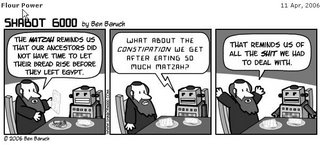
Shabot6000 has another funny cartoon related to Pesah. The only scientific record that I was able to find in Scopus on matzah is related to a study on Passover Hand Injuries


And while talking about Scopus here is the view of Jerusalem from Mount Scopus.


Clustering versus faceted categories for information exploration


Ok, Google and Google Scholar are not big fan for refining search results by using clustered topics, but Marti Hearst's very informative piece at Communications of the ACM describes the difference between hierarchical faceted categories (HFC) (flamenco, endeca) and clustering (clusty) and their usefullness for information exploration.

Her usability studies shows that "HFC-enabled interfaces are overwhlemingly preffered over the standard keyword-end-results listing interfaces."

Sunday, April 09, 2006

GM, transparency, noise, S-chip and silencing mother in-laws

GM got a lot of comments lately beacuse of the Tahoe videos created by individuals for the aprentice contest but a quiter ride for its cars is in the horizon.

From Israel21:

"Thanks to the Israeli technology of Silentium, automakers such as General Motors will be able to give Americans a quieter ride.

Based in Rehovot, Silentium began working with GM two years ago with a $250,000 R&D agreement. The deal was that if Silentium could silence the air conditioners in GM's Yukon SUV, the U.S. manufacturing giant would help Silentium get its wheels wet in the American automotive industry.

It worked."

"When asked if Silentium's technology could work on silencing in-laws or noisy neighbors, Barath responds to what he said is an old joke, "If I had a dollar for every time someone asked me that question," laughs Barath, "I would be a very rich man. In-laws are much more complicated than fans. I could silence my mother-in-law if she had the right spectrum in her voice. But our engineers at Silentium are not magicians. Noise needs to be predictable in order for us to cancel it. I don't believe you can predict your mother-in-law."

"While Big Companies Deliberate, Small Companies Obliterate"

Fred Wilson's remarks sound a bit familiar

Microsoft Academic Search and challenging future for A&I vendors

Ok, we knew that Microsoft was coming with something similar to Google Scholar and now it seems that it will be launched on April 11. via Dean Giustini

I don't know if anyone from Elsevier was invited to Redmond to get a peak. It will be interesting to see what would be the uniqueness of Micorosft Academic Search compared to Google Scholar. Definetly we don't need another mee-too products. Eventhough Google does not find useful, I hope that Microsoft Academic Search team implements a refinement of search results by clustering or some other way.

And in the bibliographic database vendors land Tuesday will be another day when CEOs, product and strategy people, marketing and sales departments will be talking on "where we go now? how many more years we can stay just as an A&I vendor........"

I believe having Microsoft and Google (who knows in the future may be Yahoo and Ask now that Gary Price is with Ask) in scholary research is a great challenge for all the A&I vendors (Elsevier, Thomson, CSA, OVID etc) and it makes my job more fun when I am competing with some of the best minds and innovative companies.

To differentiate our products from Microsoft and Google's free products, we all need to use our creativity and start providing intelligence and insights with our content, leverage our existing taxonomies and invest more in conceptual indexing, better anticipate users needs, personalize the search results and provide answers to the users, connect our users to each other and their extended network, make the interfaces more interactive like a game console, have users interact with our systems, and even provide APIs and have them create their own portals with our data ......................

(check this team's information portal for Marine Biological Laboratory Woods Hole Oceanographic Institution they definetly deserve an award from SIIA or any other organization that you may think of) .That's one of the most innovative vertical search portal that you can get!

Bibliographic Databases and Blogs coverage

LexisNexis a sister company of Elsevier will integrate blogs from Newstex into their online services to meet customers demand.
May be very soon we'll see bibliographic databases start covering the most linked blogs and index them using their subject specific taxonomies and authors tags.

Why one should use blogs?

from Dave Winer

"To me, asking why you should use blogs is like asking why you should answer the phone. It might be a customer, a developer who wants to use your services, or a reporter who wants to write about the company. Your competitors answer the phone, so you should too."

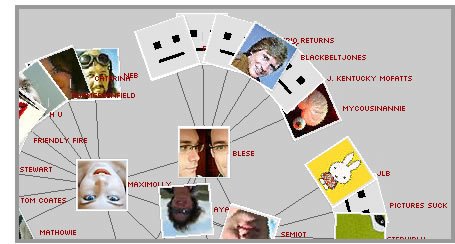
Visualizing social relationships in flickr

Flickr Graph explores relationship inside flickr.
The company Marumushi who built this has also a nice treemap implementation with news using google's api


Let's see if and when Connotea will introduce something like this to show the networking/relationship among the userbase

Saturday, April 08, 2006

Tag cloud and Times


The new design of NYTimes includes tagclouds. viaPaul Kedrosky

Google and Clustered Search results

In an intreview with Spiegel when asked about narrowing search results by clustered topics Marissa Mayer stated that: "Do you want to know what I really think of this? It’s interesting, but not really useful.”

"She adds that the majority of users don’t really want to narrow their search, they want an instant answer, and that for those users Google gives the fastest results." via GoogleBlogoscoped

I think clustered topics are more than interesting, clustering search results is definely useful. For Google this might not be useful beacuse they need to give away real estate in their screen where they are getting revenues. Users do not want to get just "faster resuts" but useful results and insights from the results.
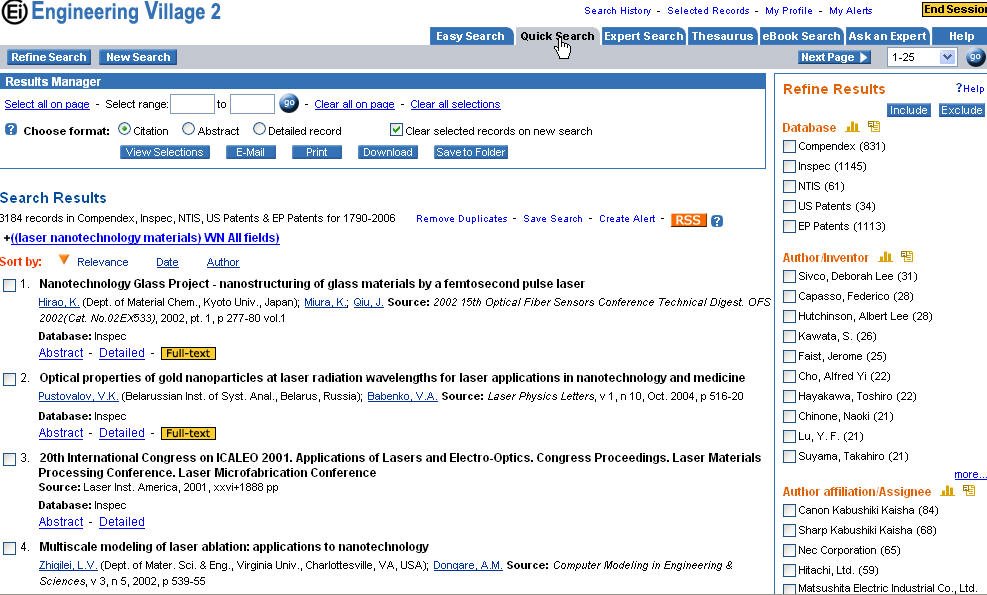
I am not sure if Marissa Mayer saw some of the clustered results implementation that are available in reseach environments. Here is an example of a search for "laser nanotechnology materials" in Google Scholar and Engineering Village. Using the Engineering Village's clusters, I can find some "answer" like most prolific author, affiliation etc whereas Google Scholar just dumps the results.


Techessence. Info: The essence of technology for librarians without the hype

A new blog for "accurate, understandable explanations of important information technologies for libraries" by Roy Tennant, Andrew Pace, Dorothea Salo, Eric Lease Morgan, Jenn Riley, Jerry Kuntz, Marshall Breeding, Meredith Farkas, and Thomas Dowling . via Meredith

Thursday, April 06, 2006

Connatea introduces Scientific Profile

Connatea team continues exucuting! They definetly have the right idea and vision with social networking within scientific community. Now they have a wiki to create a profile. via Timo Hannay and Pierre Lindenbaum. I agree with Pierre that using FOAF one can do terrific staff with the profiles. We the giants (Elsevier and Thomson) should learn from Nature on how to adapt and develop products in today's web.

Wednesday, April 05, 2006

Google Related Links

Google Lab introduces Google Related Links. See the right hand side of the screen. via Greg Linden

Monday, April 03, 2006

Impact Factor meet Blog Factor

Postgenomics "collates posts from life science blogs and then does useful and interesting things with that data. For example, you can see which papers are currently being discussed by neurologists, or which web pages are being linked to by bioinformaticians.

It's sort of like a hot papers meeting with the entire biomed blogging community."

They have a nice integration with Connotea and Pubmed. I think the "Blog Impact factor" would be an interesting challange for ISI ( Thomson) to come up with a general impact factor in the future as more and more scientists will share and communicate knowledge through web