Thursday, August 31, 2006
Transforming Scholarly Communication Symposium
The Symposium is organized by University of Houston Libraries, interestingly there is not any representatives from major STM publishers among the speakers. via William
Patent Reviews in Wiki format
In cooperation with USPTO IBM, Microsoft and HP are putting some of their patents to be reviewed in a wiki platform.
Wired News experimenting with Wikis
Interesting experiment from Wired. One can edit the article that was started by Wired News reporter Ryan Singel. The final piece will be published on September 7. We should be doing similar experiments with some of our journals too. via Ross Mayfield and Rich Hoeg
Quick move from Thomson Scientific
It was just in July that that they announced a partnership with ScholarOne and today they acquired ScholarOne If Scopus was not around, I wonder if Thomson would have acquired ScholarOne. Once again, competition is good for the market and eventually customers will benefit from all the enhancements that Elsevier and Thomson are incorporating in their products.
Monday, August 28, 2006
Top 10 web applications from Turkey
While the mullahs are trying to cover women in Turkey here is the top 10 applications via readwriteweb
Matching information seeking students with experts
Resolvequery "provides seekers convenience of getting their queries answered quickly in a meaningful manner" via webyantra
Saturday, August 26, 2006
Bringing the Mullahs through fashion

Friday night I felt like I was watching a scary movie at PBS when we saw Turkey's Tigers. It seems that Turkey is going down the tubes with growing Islamic influence. If the Kemalist and secularist don't get their act together we may see another little Iran around the corner.
Friday, August 25, 2006
Nature's experiment with Creative Commons and advise for the publishers
It's easy to understsand all the recent Nature's initiatives once you pay attention to Richard Charkin's strategy
"It's the ones who experiment that will survive the online world, not the ones who stick rigidly to the traditional business models" via Charkin Blog
Macmillan released the CC edition of Blood, Sweat and Tea a book based on Tom Reynold's experience as an EMT. They also provide the print version of the book.
"It's the ones who experiment that will survive the online world, not the ones who stick rigidly to the traditional business models" via Charkin Blog
Macmillan released the CC edition of Blood, Sweat and Tea a book based on Tom Reynold's experience as an EMT. They also provide the print version of the book.
Thursday, August 24, 2006
An MLIS student view on academic library
"Academic "Library 2.0 Concept Model Basic v2" is Michael Habib's version of interaction between physical space and virtual space.

Wednesday, August 23, 2006
Taking Faceted Search to a new level
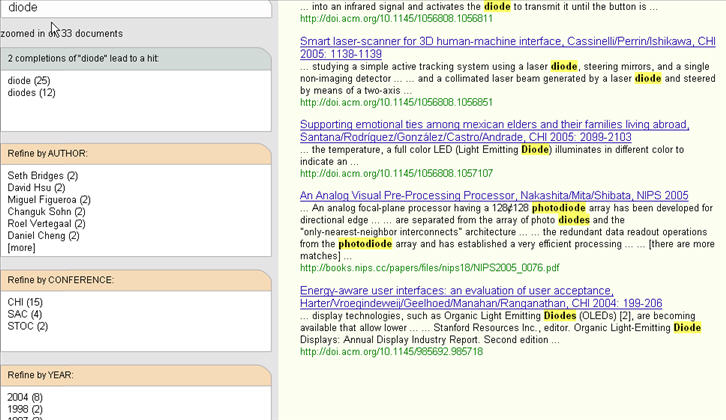
Holger Blast and Ingmar Weber's (both from Max-Planck-Institut für Informatik) faceted autocompletion prototype is an excellent example of using faceted search and integrating autocompletion feature.Basically no need to click the search button. It's like dynamic search.
Tuesday, August 22, 2006
Scopus gets a well deserved thumbs up from Shore
Scopus new feature "Selected Sources" gets a positive review from John Blossom.
"It's "low hanging fruit" from a product design perspective but as a first step it's an exciting hint of what scientific publishers can do to develop high-margin services that amplify the value of an enterprise's intellectual property significantly."
Customer Focused Entreprise
A new IBM study by Adam Klaber and Steve LaVelle offers six new competencies to create a customer focused enterprise:
You can listen the podcast here or read the transcript.
Customer authority
Customer dialog
Integrated execution
Solution experience
Human performance
and the customer-focused organization
You can listen the podcast here or read the transcript.
Related Articles at Google Scholar and Minimum Wage
Here is the announcement by Luiz Barroso.
I would not put this enhancement like how Luiz said it "Think of it as a way to hop from one giant's shoulder to the next!" but still it's good to see that they are adding some feature to Scholar so that using Google for research won't be like working less than minimum wage.
I would not put this enhancement like how Luiz said it "Think of it as a way to hop from one giant's shoulder to the next!" but still it's good to see that they are adding some feature to Scholar so that using Google for research won't be like working less than minimum wage.
Monday, August 21, 2006
Start Blogging
Dan Cohen who is an Assistant Profesors of History and Art History invites all the professors to blog in the new academic year.
" Blogs are just like other forms of writing, such as books, in that there's a whole lot of trash out there—and some gems worth reading. It just depends on what you choose to read (or write). And of course many (most? all?) other genres of writing have elements of self-promotion and narcissism. After all, a basic requirement of writing is the (often mistaken) belief that you have something to say that's important"
Education and Second Life
Sarah Robbins' dissertation is on "education and identity in second life". May be it's time that we at Elsevier dedicate at least an intern to see what's happening in Second Life...
Faceted Search and Fast Autocompletion
Holger Bast's presentation on fast autocompletion at Google TexhTalks and his paper at SIGIR 06"When you are lost with words: faceted search with autocompletion"
note:Apologies to Holger for misspelling his name as Herbert in the original post.
note:Apologies to Holger for misspelling his name as Herbert in the original post.
Using Engineering Literature
A new book edited by Bonnie Osif.
Contributors (many friends of Ei) include Aleteia Greenwood , Andrew Otieno, Barbara Opar, Bonnie A. Osif, Carol Reese , Dana Roth, Godlind Johnson, Helen Smith, Hema Ramachandran , Jean Piety , Jerry Kowalyk, Jill H. Powell, John Piety, Kathy Fescemyer , Larry Thompson, Linda Martinez, Linda Vida , Lois Widmer, Mary D. Steiner , Mary Francis Lembo, Mary Osorio, Mel DeSart , Michael Chrimes, Nestor L. Osorio , Randy Reichardt , Renee McHenry, Rita Evans, Thomas W. Conkling.
I look forward to reading it when it's available. You can pre-order it here
Contributors (many friends of Ei) include Aleteia Greenwood , Andrew Otieno, Barbara Opar, Bonnie A. Osif, Carol Reese , Dana Roth, Godlind Johnson, Helen Smith, Hema Ramachandran , Jean Piety , Jerry Kowalyk, Jill H. Powell, John Piety, Kathy Fescemyer , Larry Thompson, Linda Martinez, Linda Vida , Lois Widmer, Mary D. Steiner , Mary Francis Lembo, Mary Osorio, Mel DeSart , Michael Chrimes, Nestor L. Osorio , Randy Reichardt , Renee McHenry, Rita Evans, Thomas W. Conkling.
I look forward to reading it when it's available. You can pre-order it here
Scientific Progress , Iran and Ataturk
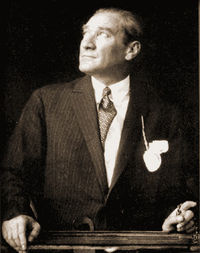 According to New York Times Ayatollah Ali Khamenei
 "accused the West of wanting to obstruct scientific progress in the Islamic world and called for Islamic countries to stand together in the face of such pressure. "Sientific Progress??????
With so much of surplus of oil money which can go to education of men and women, I wonder why Iran is not mentioned in the ISI Essential Science Indicators
 created by Thomson
 Am I missing something in this whole picture? OK, god forbid that Khamenei and Ahmadinejad should compare Iran to the Zionist entity which is ranked 16th, but how aboutScottland with 5 million population, $130B GDP , they are ranked 13th. Where is Iran with 68Million population and $555B GDP?
I don't have the full Thomson Essential Science Indicator list but if anyone is reading this Blog from Thomson Scientific, I would appreciate it if you could provide Iran's ranking in the science indicator, so that I can start tracking Iran's scientific progress.
To be frank I would like to see Iran in the top 20. Probably when they are in the top 20 we'll have less problems.....
btw What we need in Middle East and other muslim countries is more Mustafa Kemal Ataturk's
Sunday, August 20, 2006

Friday, August 18, 2006
New Creativity Index
Jose Soler came up with a new "creativity index" by analysing scientific publications.
I don't think that the terminology of this index is correct? I would prefer to call this something else. How about a physicist who is getting a ridiculous amount of money from her university to support her family, and getting no funding for her research, no funding to buy books and articles and still doing an excellent job teaching and contributing to the society. May be this physicist deserves the most creativity honor.
" According to his definition of creativity, a paper that has lots of references but only a few citations will have a low level of "creativity", while a paper with just a few references and lots of citations, in contrast, will have a very high creativity. The creativity index (Ca) of a particular scientist can then be calculated by summing the total creativity for every paper that author has written, normalized for the number of co-authors in each case."Using ISI Web of Knowledge, he found that Philip Anderson is the most creative physicist in the world. It would be interesting to see the results of this methodlogy using Scopus . What happens if he is not? Are we (Elsevier and Thomson) now in the business of deciding who is the most "creative" scientist?
I don't think that the terminology of this index is correct? I would prefer to call this something else. How about a physicist who is getting a ridiculous amount of money from her university to support her family, and getting no funding for her research, no funding to buy books and articles and still doing an excellent job teaching and contributing to the society. May be this physicist deserves the most creativity honor.
Thursday, August 17, 2006
Free e-Text books brought to you by (You Name It)

FreeLoad Press is offering free e-text books that includes advertisements. If the quality is good, I don't have any problem seeing a milk-shake or car ad... More at Washington Post via Ilya Vedrashko
Good move by FreeLoad.
Wednesday, August 16, 2006
We are in good company if Google is after our users
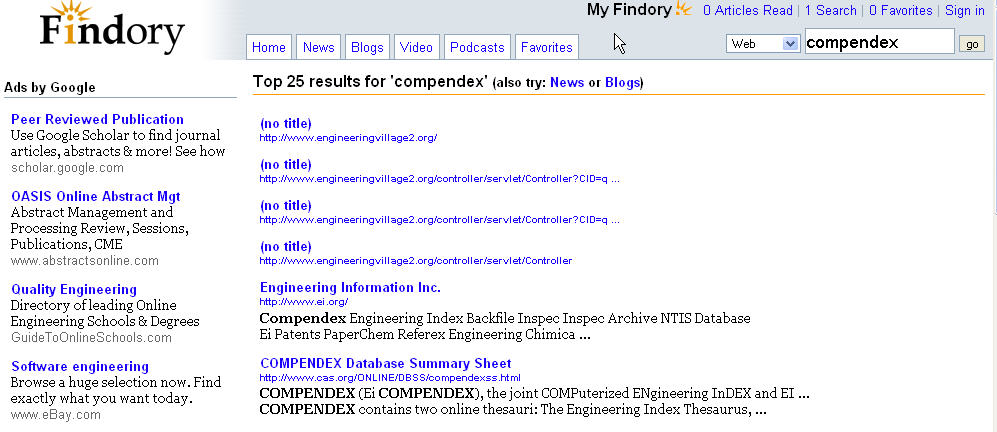
I was testing Findory's new personalized search and searched for Compendex and noticed that the first ad pushed by Google was for Google Scholar " use Google Scholar to find journals articles, abstract and more".
MeX: Brings some humor and visualization to search,
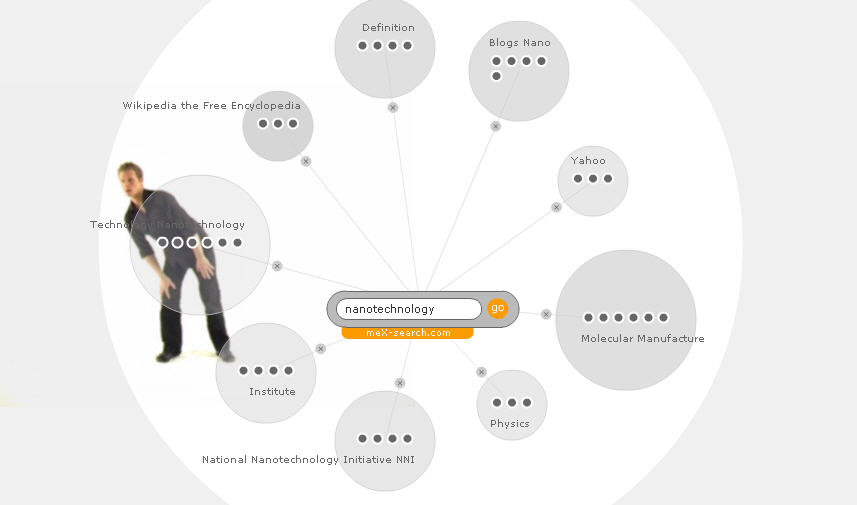
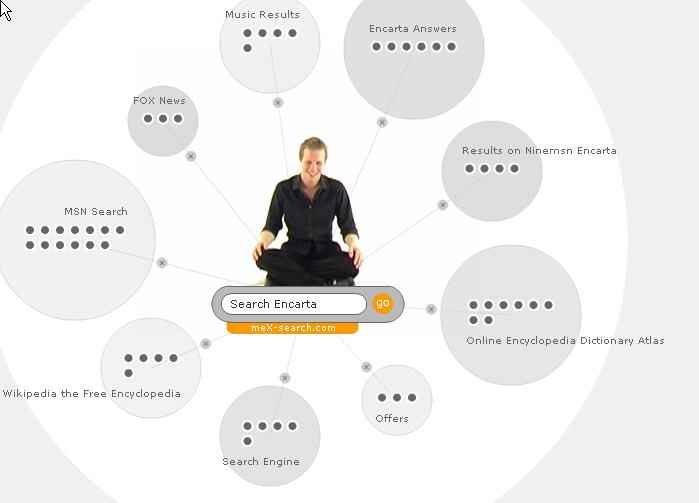
MeX Search visualize the search results with an attititude.... They use carrot-search technology for their search.
Now we need "Bring the Noise" of search with some music behind it...
Tuesday, August 15, 2006
Science Foo Camp
Here is what scientists were talking this past weekend at SciFoo.
"I'd like to discuss the range of applications being discussed in HE (HigherEd) that permit faculty and research groups to store and share a wide range of scholarly assets, including research data, texts (articles such as pre-prints and post-prints), images, and other media. These next generation academic apps provide support for tagging, community-of-use definitions, discovery, rights assertions via CC, and new models of peer review and commentary. Early designs typically implicate heavy use of atom or gdata for posting and retrieval, lucene, and ajax."
"I can describe our general approach for open collaborative biomedical research at The Synaptic Leap. "
"I could talk about insights gained as part of the NSF-funded Pathways research project (Cornell U, LANL) that looks at scholarly communication as a global workflow across heterogeneous repositories and tries to identify a lightweight interoperability framework to facilitate the emergence of a natively digital scholarly communication system. Think introspecting on the evolution of science by traversing a scholarly communication graph that jumps across repositories. I could also talk about work we have been doing with scholarly usage information: aggregating it across repositories, and using the aggregated data to generate recommendations and metrics."
"Laboratory Information Management Systems (LIMS) for small labs with BIG data. It is embarrassing how many scientists use Excel as their database system – but even more embarrassing is how many use paper notebooks as their database. New science instruments (aka sensors) produce more data and more diverse data than will fit in a paper notebook, a table in a paper, or in Excel. How does "small science" work in this new world where it takes 3 super-programmers per ecologist to deploy some temperature and moisture sensors in a small ecosystem? We think we have an answer to this in the form of pre-canned LIMS applications."
University California and Google Deal
Should the agreement be public for a public institution? Interesting commentary by Jeff Ubois via Dave Winer
Collaborative Tagging as a discovery tool
"Collaborative Tagging as a Knowledge Organisation and Resource Discovery Tool" (pdf) by George Macgregor and Emma McCuulloch from University of Strathclyde.
"Equally, collaborative tagging can not be entirely dismissed by librarians or information professionals in the manner that tagging proponents dismiss controlled vocabularies..... The need to engage users in the development of control vocabularies has been recognised by vocabulary experts and collaborative tagging systems could potentially provide a base model for such approaches. Ultimately the dicthotomous co-existence of controlled vocabularies and collaborative tagging systems will emerge; with each appropriate for use within distinct information contexts: formal (e.g. academic tasks, industrial research, corporate knowledge management, etc.) and informal (e.g. recreational research, PIM, exploring exhaustive subject areas prior to formal exploration, etc.)."
Using Google for research and minimum wage
"Using Google for research is like “working for less than minimum wage” Apple’s Steve Jobs has compared the process of searching for and downloading free, pirated music files to “working for less than minimum wage”—just as Anderson describes it as an “it’s not worth it” moment. Jobs meant that the time spent searching for and downloading illegal music files—whose quality is more often dubious than not—ends up costing the user more than 99¢. For 99¢, the individual gets a quickly downloadable, guaranteed, high-quality music file. Libraries are often perceived as inconvenient, if they are considered options at all. Libraries will regain market position when we deliver more than Google can, for less than the Google equivalent of 99¢—when we are “worth it.”Katherine Bossman's article "Serving the Niche" on Library Journal
Monday, August 14, 2006
Scifoo attendees enjoyed Google Cuisine
It seems that Scifoo adopted Chatten House rules for this by-invite only event organized by Nature, O'Reilly and Google. Use Scifoo tag at Connotea to follow the postings. via phylogenomics
Also here is a brief report . Interesting topics include scientific tools, collaborative research, open science and a presentation by Linden Lab on SecondLife. by Nadalpoint
I was wondering which other publishers (without attendees names) were invited to this meeting to talk on these topics which are also crucial to STM publishing community.
Also here is a brief report . Interesting topics include scientific tools, collaborative research, open science and a presentation by Linden Lab on SecondLife. by Nadalpoint
I was wondering which other publishers (without attendees names) were invited to this meeting to talk on these topics which are also crucial to STM publishing community.
Thursday, August 10, 2006
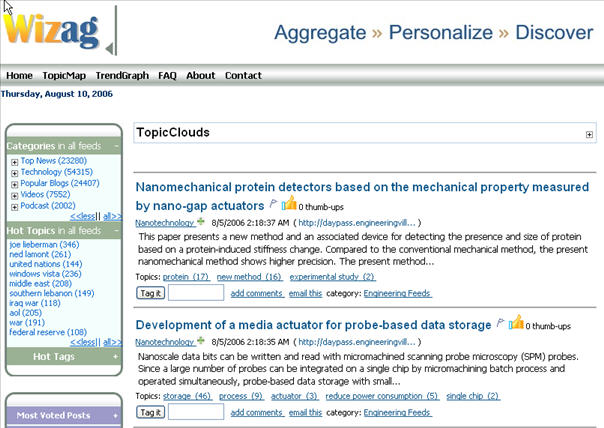
A new research search engine that rocks: Rexa
My quick impression: this is a very clever implementation. Very well done by a team from UMass . Beside many cool stuff it has H-index too. via Stephen Green
Wednesday, August 09, 2006
Science Foo Camp
Nature, Google, and O'Reilly are organizing the first Science Foo Camp. It's invitation only for "the greatest thinkers in science and technology". The invitee list is not posted but I do hope someone from Elsevier got an invite. via Nascent
Want to improve employee opinion surveys (EOS)?
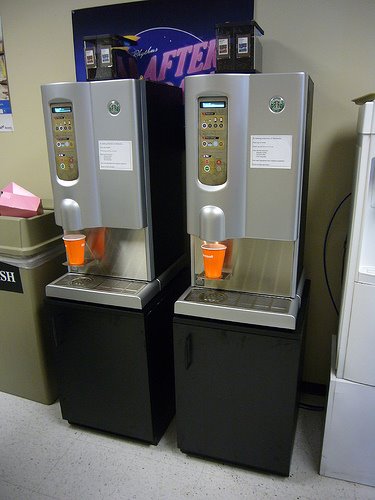
Get one of these Starbucks Interactive Cups and replace the pots. Via Adam Kinney
For my coffee taste, Starbucks can't come close to a good Turkish coffee, but still that's the best I can find around 26 & Park.
Importance of searching patent literature for technologists and researchers
Michael White points to an interesting article that shows the benefit of doing thorough patent search.
"US chemists celebrated the 4th of July with publication of one of the most sought after materials - one that emulates the incredible water-repellency and pollution-protective nature of the surface of the lotus leaf. Their research could lead to a new class of self-cleaning and protective materials for use in coatings for engineering structures from bridges and buildings to vehicles and planes and even new clothes that shrug off dirt.Thomas McCarthy and Lichao Gao of the Polymer Science and Engineering Department, at the University of Massachusetts, Amherst, have taken a leaf out of the science history books to make their new material. The researchers have combined the work reported in a patent on water-repellency from 1945 with cheap commercial textiles to create what many materials scientists see as a Holy Grail in their field." from Institue, science, engineering, technology
Aussies on citation counts
The Australian article on citations.
At least we the publishers and our products (like Scopus and ISI Thomson) are not the only culprits.
At least we the publishers and our products (like Scopus and ISI Thomson) are not the only culprits.
"What is coming through very, very clearly is that people are manipulating citations" said Colin Steele, an expert on scholarly communication. The culprits were publishers, academics and "by implication, vice-chancellors," he said."
"Gordon Parker, a psychiatrist of depression who directs the Black Dog Institute affiliated with the University of NSW, said a high count was one useful signal of a researcher's work. "But we also need other signals," Professor Parker said. "Is there quality as against mere quantity? Is the output respected by peers in the field?"
"Mr Steele, an emeritus fellow and former librarian at ANU, said academic publishing was suffering from "article obesity"."
Tuesday, August 08, 2006
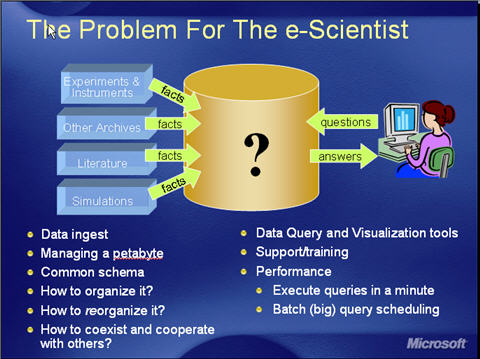
Microsoft is aiming to solve scientist workflow problems

More insights at Dan Fray's (Director North America Technical Computing at Microsoft) presentation (ppt)
Major publishers like Elsevier, Thomson, Kluwer also are developping product (Scopus, WOS etc) to solve workflow issues.
Life is never dull in product development.
Economy professors and blogging as a global educational tool
"So why do it? “It's a place in the intellectual influence game,” Mr DeLong replies ...... Mr DeLong caps his blogging at 90 minutes a day. His only blog revenue comes from selling advertising links to help cover the cost of his servers, which handle more than 20,000 visitors daily."via Economists' Blogs
I don't think that any paper that Prof. Delong has published was downloaded 20,000 times in one day.
More questions on the benefit of blogging for collaboration and education. May be there should be a similar campaign like "this is your brain on drugs" stating "this is your brain with no blogs"
GE brings good things to life
Who would have thought this coming out from GE. Using Imagination Cubed you can invite a friend draw together on a whiteboard.
Starwood goes to Second Life
" This September, Starwood Hotels will become the first company in history to open a new hotel brand inside of a virtual world. via Ilya Vedrashko
I am still waiting for a new video card or a new laptop to see what's happening in Second Life. I have read some activity on our librarians colleagues but I haven't seen anything from major information solution vendors and scientific publishers in SL.
If there is any publisher doing anything interesting there please let me know.
I am still waiting for a new video card or a new laptop to see what's happening in Second Life. I have read some activity on our librarians colleagues but I haven't seen anything from major information solution vendors and scientific publishers in SL.
If there is any publisher doing anything interesting there please let me know.
Develop without Borders
Microsoft's program sponsored by HP is for developper to design application using Microsoft software. Prizes will be shared between the developper and his/her private charity. Good initiative whick will help them to get some product ideas too.
Monday, August 07, 2006
SIGIR 2006 and Faceted Search
29th annual SIGIR,the ACM's conference on Research & Development on Information Retrieval, is taking place in Seattle. Here is Microsoft's papers presented in SIGIR from 2004-2006.
There is also a workshop on Faceted Search organized by Andrei Z. Broder, Yahoo and Yoelle S. Maarek, Google.
It's good to see the major search engines paying attention to faceted search. If Yahoo and Google and MSN implement faceted search in a clever way they will contribute big time to information retrieval and cut the time spent to find information.
There is also a workshop on Faceted Search organized by Andrei Z. Broder, Yahoo and Yoelle S. Maarek, Google.
It's good to see the major search engines paying attention to faceted search. If Yahoo and Google and MSN implement faceted search in a clever way they will contribute big time to information retrieval and cut the time spent to find information.
Macmillan CEO Invites you to debate Open Access
Richard Charkin who is the CEO of Nature's parent company Macmillan, presents his opinions on open access and invites his readers and customers to join the debate at Nature News Blog.
This is an excellent way for a CEO to be in touch with the market and customers.
This is an excellent way for a CEO to be in touch with the market and customers.
Sunday, August 06, 2006
Carnegie Mellon Graduate Students' Information Seeking Behavior
Great paper on "Scholarly use of information: Graduate students' information seeking behavior" by Carole George, Alice Bright, Terry Hurlbert, Erika Linke, Gloriana St. Clair and Joan Stein from Carnegie Mellon University Libraries. The authors interviewed students in 6 different disciplines including engineering and science.
Commoditization of Knowledge
I just watched live the last part of David Weinberger's presentation on What's happening to knowledge at Wikimania 2006. In the part that I was watching he emphasized on "meaning", "conversation", "theirs and ours" in terms of who provide knowledge, and withdrew some similarities to the conversation and interpration that happen in Talmud in learning and finding meaning to todays conversations in learning.
Wikimenia and Wikis as collaborative tools in entreprise
Wikimenia conference is taking place in Boston this weekend. Rich Hoeg who is a manager at Honeywell is one of the attendees who is blogging from the conference. In his blog he mentions that some of the Honeywell engineers are using wikis for collaboration purposes. Another proof of use wikis in corporate engineering market is Atlassian's customer list. At lof of technology companies in that list. Atlassian was launched by two young Aussies, Mike Cannon-Brookes and Scott Farquhar.
Rich also asks a question which is close to our heart at Brewster Kahle's presentation on Universal Access to All Knowledge
Here is the notes on Rich's question and Brewster's answer refering to PLoS
As Elsevier if haven't done yet, we should invite Brewster to either Amsterdam and New York and get his perspective on Universal Access to All Knowledge.
Rich also asks a question which is close to our heart at Brewster Kahle's presentation on Universal Access to All Knowledge
"I asked about any efforts involving the various engineering and technical societies. As background, companies like Honeywell sumbmit papers to the societies without charge, but then lose the rights to those same papers. Believe it or not, those same engineering societies then turn around and try to sell companies electronic access for hundreds of thousands of dollars.To make a long story short, I sent an email to the folks at Internet Archive this afternoon offering to be a point person for working this issue (i.e. when papers are submitted, rights would also be retained via Creative Commons and the actual papers would be stored on the Internet Archive). We'll see what happens .." link
Here is the notes on Rich's question and Brewster's answer refering to PLoS
Rich, let us know what happens.Q: Engineering societies submit papers, for free, to IEEE, who turns around to charge us.
A: Public Library of Science. I like the ideas of science but we let a few orgs take control of it. It's very painful. We're having to build whole new systems to replace them; it's terrible to have to repeat ourselves. So let's to it right next time.
As Elsevier if haven't done yet, we should invite Brewster to either Amsterdam and New York and get his perspective on Universal Access to All Knowledge.
Friday, August 04, 2006
Trust in Google, not yet
Steven Bell who is the Director of the Library at Philadelphia University posts about an article in the Thomson Gale Report, by Brittney Macomber who is a senior at Denison University.
Brittney summarizes what we have to do as an industry:
This is valid also for corporate engineers who are wasting millions of dollar and productivity time in scientific literature search. As vendors serving the corporate market, we have to show the value and the power of products build on subject specific databases to small medium entreprises or large corporations.
Brittney summarizes what we have to do as an industry:
Bottom line: large database providers and librarians need to do a better job at marketing to the faculty and students - the people who actually need and will use the authoritative content and research tools they provide. Without this concerted effort, it appears that a lot of money and time is wasted letting these valuable online databases collect virtual dust!
This is valid also for corporate engineers who are wasting millions of dollar and productivity time in scientific literature search. As vendors serving the corporate market, we have to show the value and the power of products build on subject specific databases to small medium entreprises or large corporations.
Exalead revamp
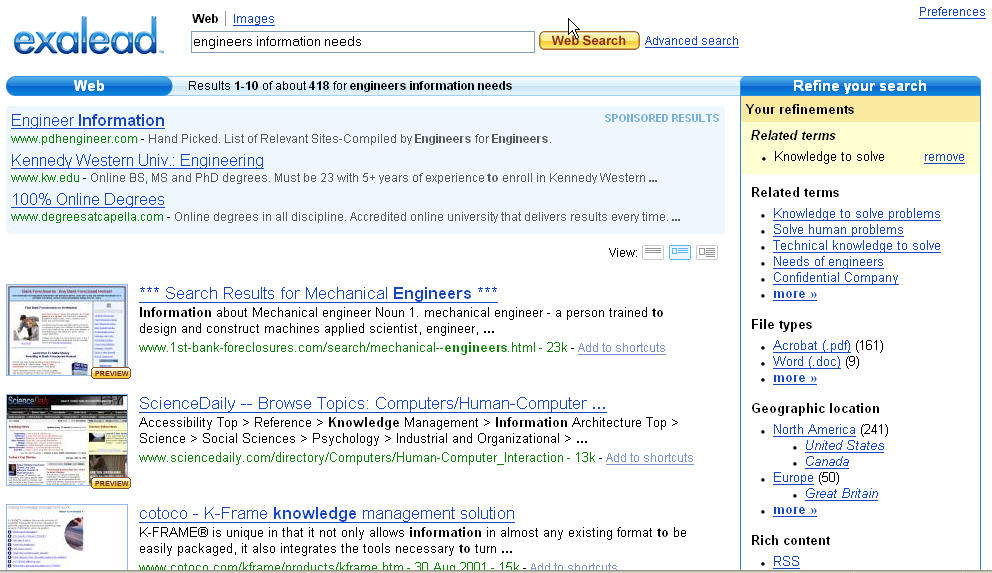
The search company exalead is coming up with new ehnancements that will make the search refine feature easier.
They are moving their refine box from left to right similar to Engineering Village and Factiva's Search 2.0 interface.
I am wondering what was the main reason for this move?
Last week I got an interesting feedback about the location of our refine search box where faceted search (or should I say "guided navigation") is in action. One user stated that he wished that the refine search box was someplace else because of all the sponsored ads that he gets in general search engines like Google, Yahoo etc, he ignores the right hand side of the search result screen.
Tuesday, August 01, 2006
Open Access to Nature's Backfiles Society Publications
"Nature Publishing Group (NPG) will soon be opening online access to all archive content published in the academic and society journals before January 2003. The archives will be accessible from January 2007. " via Issues in Scholarly Communication
New Blog from Penguin Books

Here is what the blog will cover
"Having led the way in bringing publishing into the digital age with its award-winning podcasts, Penguin's blog will be a destination where an editor will post the latest news from the company: new acquisitions, sneak previews from works in progress of some of Penguin's best-loved authors, industry gossip and advice on how to get published. The blog will give readers a glimpse into the editor's office, offering insight into the day-to-day running of the company and how books are made. "
I hope my primary publishing colleagues in books and journals are taking notice of this initiative by another publisher. via Joe Wikert a publisher at Wiley.